
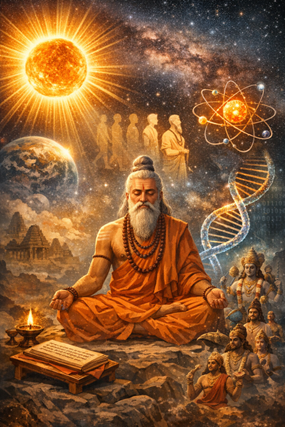
Echoes of Modern Science in Ancient Indian Thought
Modern science is capable of exploring reality across scales, starting from the quantum world of subatomic particles to the vast observable universe. With each scientific discovery, we refine our understanding of nature and our place within the cosmos. Interestingly, some of these modern realizations find intriguing conceptual similarities in Indian philosophical and literary traditions. Ancient …
Echoes of Modern Science in Ancient Indian Thought Read More »
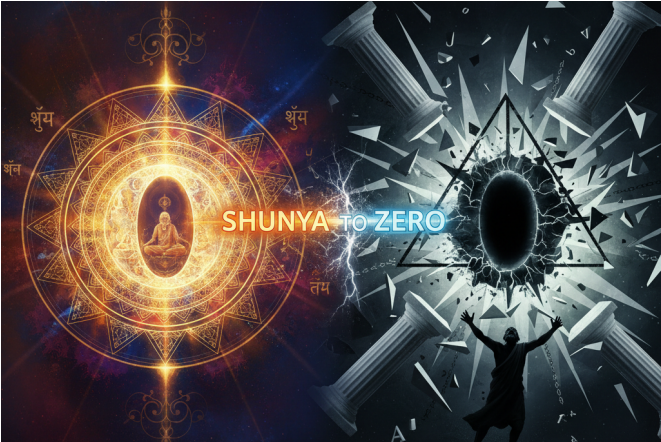
From Shunya to Zero
Imagine a number so powerful it terrified the Greeks for two thousand years and yet was celebrated as divine in India from the very beginning. The Greeks, who saw the universe as a perfect harmony of numbers, could not fathom shunya (zero). Pythagora believed that “all was number” and everything in nature, music, geometry, and …

From Self to Society: A Civilizational Perspective on India’s Socio-Economic Ethos in Mahabharata
India is not merely a geographic nation. It is a cultural platform, a spiritual compass, and a civilization that has shaped a dharma-centric way of life. The socio-economic journey of India can be viewed as a struggle between foreign ideologies and indigenous ways of living. In the 20th century, two dominant socio-economic systems Capitalism and …
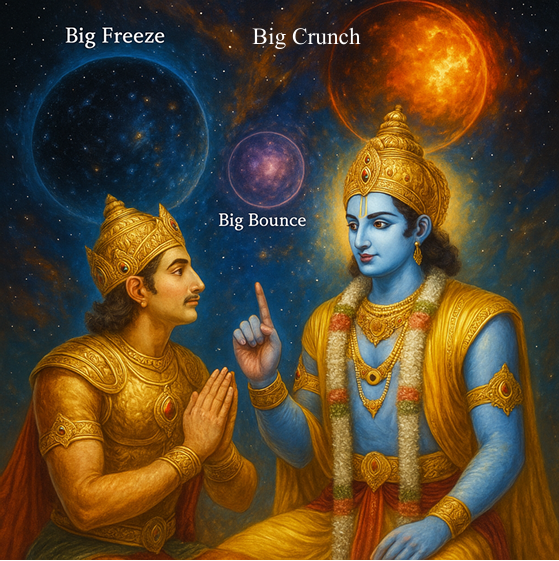
Cycles of the Cosmos: Echoes of Bhagavad Gita in Modern Cosmology
Across cultures and centuries, the skies full of celestial bodies have captivated humans, compelling them to ask the most fundamental questions: Where did all this come from? On a deeper level, where did the universe itself originate? Will it last forever, or does it move in a rhythm beyond our current grasp? This timeless curiosity …
Cycles of the Cosmos: Echoes of Bhagavad Gita in Modern Cosmology Read More »
