
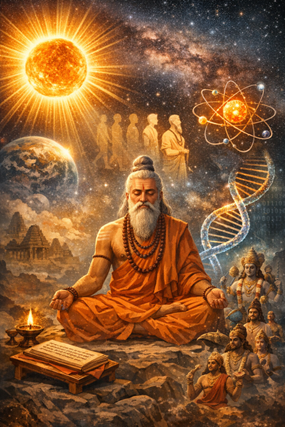
Modern science is capable of exploring reality across scales, starting from the quantum world of subatomic particles to the vast observable universe. With each scientific discovery, we refine our understanding of nature and our place within the cosmos. Interestingly, some of these modern realizations find intriguing conceptual similarities in Indian philosophical and literary traditions.
Ancient Hindu texts addressed many of the same fundamental questions that continue to preoccupy scientists today: How did the universe originate? What is the origin of life and consciousness? What is our role in the cosmos?
This article aims to highlight similarities between ideas rooted in ancient Indian texts and those that are central to contemporary scientific inquiry. How such insights emerged and what they truly signify are profound questions that require careful and critical study. Knowledge preserved in ancient Indian texts reveals fascinating connections with several fundamental discoveries of modern science.
The speed of light
In his commentary on the fourth verse of Rigveda hymn 1.50, the medieval scholar Sayana, who served as prime minister to Emperor Bukka I of the Vijayanagara Empire, makes a remarkable statement concerning the motion of the Sun [1]:
“Thus it is remembered: O Sun, you who traverse 2,202 yojanas in half a nimesa.”
The units yojana and nimesa are well documented in ancient Indian literature. Taking 1 yojana ≈ 9 miles and 1 nimesa ≈ 16/75 seconds, this statement corresponds to a speed of approximately 3 × 10⁸ meters/seconds, which is strikingly close to the modern measured value of the speed of light.
This observation should not be interpreted as an experimental determination in the modern scientific sense. Nevertheless, the numerical proximity is intriguing for historians of science, as it suggests a sophisticated engagement with astronomical concepts in ancient and medieval Indian scholarship.
The number of species
The Vishnu Purana and other Puranas famously state that a soul after passing through 8.4 million yonis (forms of life) attains human birth. Traditionally, this number has been understood symbolically, representing the vast diversity of life rather than a literal biological census.
Interestingly, modern biology also emphasizes the immense diversity of living species on Earth. In recent studies, estimates of the total species count are within an order of magnitude of the ancient Hindu intuition [2].
The age of the universe
In the Bhagavad Gita (8.17), Krishna describes cosmic time in striking terms:
“One day of Brahma (kalp) lasts a thousand cycles of the four ages (maha yug) and his night also extends for the same span of time. The wise who know this understand the reality about day and night.”
Here, the day of Brahma, representing a cosmic cycle, is said to last 1000 yugas, followed by a night of equal duration.
A single cycle of four yugas is traditionally given as,
* Satya Yuga: 1.728 million years
* Treta Yuga: 1.296 million years
* Dvapara Yuga: 0.864 million years
* Kali Yuga: 0.432 million years
Total: 4.32 million years
Thus, one day of Brahma corresponds to
4.32 × 10⁹ years ≈ 1.36 × 10¹⁷ seconds.
Modern cosmology estimates the age of the universe to be approximately 10¹⁷ seconds. While these concepts arise from very different frameworks, the similarity in timescales is striking and reflects ancient Indian conceptions of cosmic vastness.
Do we live in a Matrix?
The idea that reality may be an illusion or a constructed appearance has gained renewed attention in modern physics through discussions of simulation theory and the so-called Matrix hypothesis.
However, the concept of Matrix (Maya) predates these discussions by millennia. The Svetasvatara Upanisad (4.9-4.10) describes how ultimate reality is veiled by Maya, giving rise to the world of appearances.
“…the Master of Maya brings forth from that all this that is and there is another whom within it his Maya holds imprisoned…”
Modern debates on simulated reality echo these ancient reflections, even though the intellectual motivations and methodologies differ substantially [3].
Evolution of life and consciousness
The theory of evolution describes how life diversified over time through natural selection, beginning with simple organisms in the seas. Interestingly, in Hindu philosophy, the concept of Dasavatara, the ten incarnations of Lord Vishnu, exists as a sequence that symbolically progresses from simple life forms to fully realized human consciousness [4],
Matsya (fish), Kurma (turtle), Varaha (boar), Narasimha (man mixed lion), Vamana (dwarf), followed by Parashurama (a forest-dweller), Rama, Krishna, and later avatars.
This sequence should not be interpreted as biological evolution in the scientific sense. Instead, it can be viewed as a symbolic narrative reflecting an intuitive progression of life and consciousness, from aquatic forms to complex social beings capable of moral and spiritual reflection.
Everything is connected
Particles, fields, and spacetime are concepts of modern physics that describe nature as a deeply interconnected web of processes, where they form an inseparable whole. This idea resonates strongly with ancient Indian philosophy.
The Mundaka Upaniṣad (2.5.5) expresses this unity beautifully,
“He in whom the sky, the earth, and the atmosphere are woven,
together with the mind and all life breathes know Him alone as the Self”
Here, Brahman is presented as the unifying principle underlying all existence, a vision remarkably aligned with modern holistic views of the universe [5].
Everything is relative
Einstein’s theory of relativity revealed that measurements of time and space depend on the observer’s frame of reference. The properties of the object alter depending on the frame of reference. While the mathematical structure of relativity is modern, the philosophical questioning of subject-object duality is ancient.
The Brihadaranyaka Upaniṣad (4.5.15) states,
“Where there is duality, one sees another…But where everything has become one’s own self, whom would one see, and by what? Once the distinction between observer and observed dissolves, relativity itself loses meaning-a profound insight that resonates deeply with both modern physics and philosophy.”
The aim of the article is to demonstrate fascinating similarities and highlight the contemporary relevance of ancient Hindu wisdom through a curious analysis. Ancient Indian texts were not scientific manuals, yet they demonstrate a remarkable depth of philosophical reflection on reality, time, life, and consciousness. Modern science, through a very different route, is now confronting similar questions and, in some cases, arriving at conceptually related insights.
A thoughtful reflection on the similarities with modern science highlighted in the article enriches our appreciation of ancient India’s long and shared quest to understand the cosmos.
References:
[1] Max Muller, Rig-Veda-Samhita together with the commentary of Sayana. Oxford University Press, London, 1890.
[2] Camilo Mora et al. How Many Species Are There on Earth and in the Ocean? PLOS Biology, 9(8), e1001127.
[3] Melvin M. Vopson, Do we live in a computer simulation like in The Matrix? Proposed new law of physics backs up the idea. Phys.org, 21 Oct. 2023
[4] Danino, M. (2011). Indian culture and India’s future. DK Printworld.
[5] Capra, F. (1975). The Tao of physics: An exploration of the parallels between modern physics and Eastern mysticism. Shambhala Publications
Author: Dr. Gaurav Tomar
